
Why Indian Subcontinent Is Unique?
My Perspective!
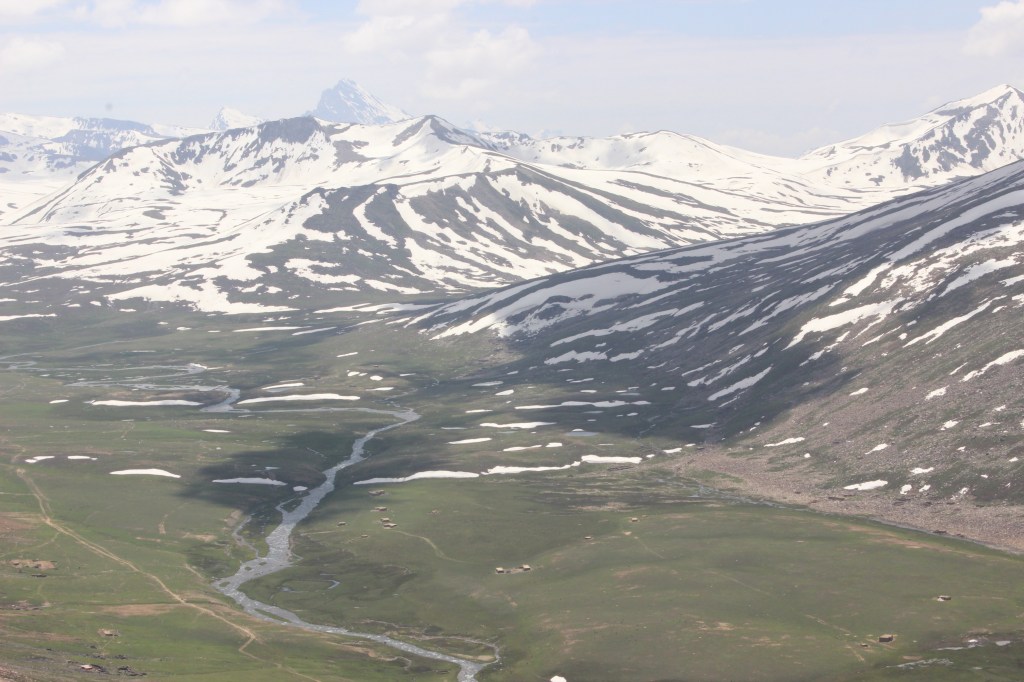
Geologically speaking, it’s believed that the tectonic plate, named Indian Plate, collided with the Eurasian Plate 50 million years ago and as a result of this collision Himalayan Range and Tibetan Plateau were formed. Before the oceanic drift and the collision this landmass was located in the Southern Hemisphere, near present Australia, as a big island. So we can safely say that Indian landmass has always been a separate and detached entity since it broke away from the mother landmasses or supercontinents, Pangaea and before that Gondwana.
Boundaries of Indian Plate
The Indian Plate, which comprises of almost 4.6 million square miles, is stretched deeply into Indian Ocean up to and touching Arabian Plate, Somali Plate, Australian Plate and Burma Plate in the South. In the North it touches Eurasian Plate up to South China but does not include Ladakh, Kohistan and the Tibetan Plateau. Incidentally, Indian Plate is continuously subducting under the Tibetan Plateau hence it’s a convergent boundary, in geological terms.
On eastern fronts Indian Plate touches Burma microplate and another subduction process is going on here. In further east, the Indian Plate is further stretched, under the Indian Ocean, to the shores of western Indonesia.

Because of many cultural affinities and being the adjacent part of British Empire, during colonial times, Burma / Myanmar historically remained part and parcel of Indian Subcontinent but geologically the situation is somewhat different. This is worth mentioning here that even the last Mughal Emperor of India, Bahadur Shah Zafar, is buried in Rangoon, the capital of Myanmar, and the last British viceroy of India, Lord Francis Mountbatten, was also designated as the Earl Mountbatten of Burma.
In the west, Indian Plate is extended up to the eastern Afghanistan where it touches Iranian Plateau which is a part of Eurasian Plate. Two provinces of Pakistan, namely Punjab and Sindh, are wholly on Indian Plate while Khyber Pakhtunkhwa is partially on Indian Plate and partially on Iranian Plateau. Balochistan is completely on Iranian Plateau (Eurasian Plate).
Geological studies reveal that the present countries which are situated on Indian Tectonic Plate are India, Bangladesh, Sri Lanka, Maldives, Bhutan, Nepal and a major portion of Pakistan.
The Indian Civilization and the Indian Landmass
The historians usually attribute ancient civilizations to rivers as life and lifestyles may never survive and flourish without the availability of water. Like the civilizations which flourished on the banks of Nile, Tigris, Euphrates, Yangtze and Amazon, India had mighty and historical rivers which contributed to the development of their respective civilizations like Indus, Ganges, Brahmaputra, Yamuna, Gomti, Sutlej, Jhelum, Ravi, Chenab and dozens of others. But, uniquely, in Indian Subcontinent the rivers themselves became the constituting part of a much bigger and huge reality, the Indian Civilization.
Indian Civilization is attached to the soil of Indian Plate. Everything, living or non-living, whichever exists on this soil, is sacred and thus to be worshipped. There is not any single God, as such, but whatever is produced from this soil is God. Rivers are gods, trees are gods but even all animals which evolved on Indian Plate, during the whole geological process as explained above, are gods. Since Indian Plate has been an independent and separate piece of land the fauna and flora which evolved on this landmass are mostly exotic for the people living in other parts of the world. From elephant (Ganesha) to tiger (Wagh), from rhino (Vahana) to monkey (Hanuman), from cobra (Sesh Nag) to peacock, from cow (Gao Mata) to water (Jal Pawater) from Peepal Tree (Ficus religiosa) to Neem Tree (Azadirachta indica) and from Himalayas to Ganges, all are to be, respected, protected and worshipped being the product of Dharti Mata (the motherland). After death the ashes of Hindus are to be flowed into the rivers of Hindustan, most divinely into the Ganges.
All three ancient indigenous religions of Hindustan viz. Hinduism, Jainism and Buddhism are borne out of Indian landmass. They all respect animals, mostly feed on plants and vegetation, believe in ascetism and adopt the life of a monk, bhikshu, sannyasi and yogi to attain the spiritual purity, living away from human societies in jungles, caves or on mountains is their idea of pleasing and cajoling the mother nature. India, Bharat or Hindustan, whatever you want to call it, is the birthplace (Janam Bhumi) of all these three religions and they couldn’t survive if detached from their soil. Now Hindus, Jains and Buddhists have immigrated to almost all parts of the globe but their religious and deep attachment to the land of Hindustan is exemplary, unparallelled and incomparable. If the land is lost the Indian civilization is lost for the original dwellers of India.
The Hindu idea of nationalism is totally different from the Muslim nationalism. Although, Muslims do love their homeland, because of being the abode of their ancestors, but their attachment to land is not religious. They believe in the concept of Umma or Millat meaning that all Muslims around the globe are like their own brethren and the whole Earth belongs to Allah and is therefore, their home. According to Islam they don’t usually adhere themselves to any particular food or any particular dress but simply believe in following broader guidelines like food must be halal and dress must adequately and properly cover their Satar (those parts of the body which are instructed to be covered in Islam). Simply, Muslims don’t need any deity or physical object, in front of themselves, to worship their God or Allah. In fact, paying pilgrimage to their holy places in Mecca and Medina, in Saudi Arabia, is also not mandatory. They may do visit if financially and physically capable, otherwise, should not.
Quite contrary to other nationals from Asia, Africa and Europe, Indians exclusively need to establish mini-Indian markets, near to their concentrations, to remain in touch with their strong culture and traditions (Parampara). Far East Asians, particularly Chinese, are also compelled to set China Towns wherever they have significant populations. This Chinese compulsion is solely because of their specific dietary habits and food choices which are not easily available everywhere in the world.
Pakistanis like me and other South Asians from Bangladesh, Nepal and Sri Lanka also rely on these Indian markets to buy foods which have become common choices. Different kinds of rice to so many varieties of pulses and lentils besides achars, chutneys, spices, papars (crackers), desi spicy snacks, chai, mithais, nans and rotis, besan, suji, paneer, makai ka atta, wheat ka atta, ghee as well as particular vegetables are the attractions for all of us Desis around the world. Where else one can find till kay laddu (sesame balls) and Heng (Asafetida) other than an Indian food store.
Another history long distinction of India – which cannot be competed even by sculpturing masters like Greeks, Romans and Egyptians – is the development of their own class of Arts in crafting idols; engraving and carving walls, mountains and temples; embossing scriptures and mythologies, in graphic, and chiseling remarkable statues whenever they have lived. I have always felt fascinated by looking at the huge statues and mountain engravings of Mahatma Buddha right from Leshan in China to Bamiyan in Afghanistan – definitely the most widely sculptured person in the history. Similarly, the marvelously chiseled mountains, rocks and caves of Ajanta and Allora, in Maharashtra India, have already been included among one of the old wonders of the world. These meticulously decorated caves and mandars, in stone, depict and represent all three Indian religions.
Buddha’s sculptures, statues and teachings are scattered all over northern Pakistan – being the remnants of great Gandhara Civilization. On the other hand, the stories and lives of 24 tirthankaras, up to the last and the only Mahavira, as painted and engraved all over the Jain mandars in the Sindh province show the dedication and mastery, both.
The Concept of Akhund Bharat
The strong concept of holy land or motherland, which is religiously attached to the soil of Indian continent – according to our perspective the Indian Plate – has made Hindus adamant and hardened about the indivisibility of Akhund Bharat, also named in Sanskrit scriptures as Bharat Varsha. What does, in fact, Akhund Bharat mean? In simple words it means Undivided or Ancient India. The Hindus believe that originally India or Bharat included Eastern Afghanistan, present Pakistan, present India, Tibet plateau, Nepal, Bhutan, Sri Lanka, Maldives, present Bangladesh, present Myanmar, Thailand, Cambodia and Indonesia.

The reality is that their claim is not without any basis. This whole region stretched from South Asia to the Far East Asia is still replete with the remains of Hinduism and Jainism. The third ancient Indian religion, Buddhism, is practiced worldwide by around 7 to 8 % of world population (more than 500 million) but the cradle of Buddhism had been from the land of Bamiyan in Afghanistan and Gandhara Civilization in northern Pakistan up to Cambodia, Laos and Thailand. Tibet Plateau of China is actually called the land of Buddhism and their spiritual head, Dalai Lama, lives in his Dharamsala situated in the northern state of India, Himachal Pradesh – on the foothills of Himalayas.
One the other hand, before the Arab invasions in 8th Century Jainism was one of the two major Dharmas practiced in Sindh and Punjab provinces of Pakistan besides having major concentration inside central and northern India. Their origin was in Eastern India. Now, many Jains have immigrated to North America and their world population is around five million.
The primary religion of Hindustan is Hinduism. Today they reside all over the world but still their more than 90% population live in India and other countries of Southeast Asia and Far East Asia. Presently, the estimated global population of Hindus is about 1.2 billion. The oldest excavated Hindu cities were the part of Indus Valley Civilization known as Mohenjo-Daro and Harappa. Indus river is one of the two holiest rivers of Hinduism, which is now the lifeline of Pakistan. According to one popular theory the name of India was also derived from Indus. Despite facing different kinds of persecutions still Sindh province of Pakistan contains a big chunk of old practicing Hindus.
Traveling towards the east of India we can find number of traditional Hindus in almost every country till we reach Indonesia. Ancient Hindu temples can easily be located everywhere. The population of Malaysia and Singapore is still divided into three racial groups: Malay, Chinese and Indians. The Batu Caves Temple, the ancient Sri Poyatha Moorthi Temple, Sri Maha Mariamman Temple and many other Hindu temples in Malaysia reveal the deep roots of Hinduism before the Islamization of the Indo-China region in 7th Century. Old temples in the region like Angkor Wat in Cambodia, Candi Prambanan in Indonesia and about a number of two hundred old and new Hindu temples in Thailand strengthen the argument that 5000 years old Hinduism was already dominant in the region when 2500 years old Buddhism was introduced to the habitants of these archipelago nations.
Interestingly, some theorists and Hindu nationalists have established links between Hindu deities and the deities of pre-Islam Arabia. The known idols like Hubal, Laat, Manat, Uzza and Naila, as worshipped by different tribes of Arabia, are claimed to resemble contemporary Hindu deities especially Shiva / Mahadeva! Was the Arabian Peninsula also a part of Akhund Bharat?
This short article could never be exhaustive and holistic as the Indian landmass is such a huge and colorful ancient mystery which is full of riddles and enigmas. Rather, I prefer to call this writeup very first in the series of articles on this engrossing subject. Please contribute your opinions and comments for the purpose of deciding the parameters of the areas to be covered, in future.
UPCOMING RELATED POSTS …..
- What Caused Hindus Bitterly Against Islam and Muslims?
- Jainism – A Difficult Path!
- Why India Progressed but Pakistan Retrogressed?


Leave a Reply